
Many people wrongly believe that the best way to lose weight is through long, very low-intensity training sessions. That idea derives from studies conducted in Scandinavia in the 1960s that showed the human body uses more fat as fuel during low-intensity workouts than during high-intensity ones.
Some people misinterpreted these results and concluded that low-intensity training is better for fat burn. However, that is incorrect! Your body is burning fat when you burn more calories than you consume. And you will burn more calories if you do high-intensity training or, even better, interval training.
Your body doesn’t burn fat by itself. Fat burning goes hand in hand with the metabolism of carbs and protein. Even if you burn more fat during the workout, the total fuel supply returns to balance according to the energy ratio: consumed calories versus burned ones.
High-intensity training allows you to burn more calories and fat even after the training session. So if you want to get rid of the fat, train harder and try to burn as many calories as you can.
What Is Interval Training?
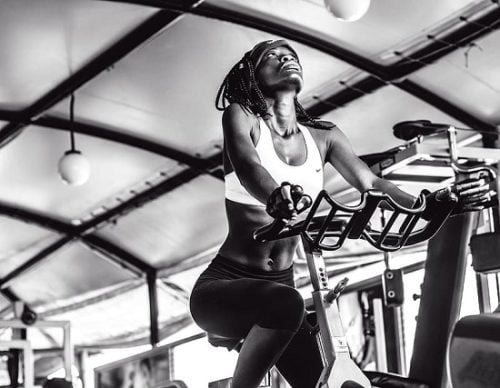
If you are training to lose weight, you should include interval training in your program. Interval training is the training in which the high-intensity training intervals switch with low-intensity training intervals or periods of rest.
Let’s say, for example, that your current training program consists of a 45-minute long spinning class during which your pulse is about 75-80% of the maximum pulse. If you use shorter high-intensity intervals (about 80-100% of your maximum heart rate), you will burn more calories in the same time.
You will also speed up your metabolism, so you will continue burning calories even after your workout. You can use interval training in any cardio exercise, including a treadmill, stepper, static bike, or swimming.
Interval training also increases the strength of your leg muscles, and stronger muscles allow you to perform exercises more easily and improve endurance. Your lower body muscles get stronger much faster with interval training than with any other type of training. Intervals are great for saving time as well.
When you know you have to run or ride a bike to reduce fat, but you can’t seem to come to terms with the fact that you will have to stare at the wall in front of you for half an hour, or you simply don’t have enough time.
That’s where interval training is very useful! During interval training, you not only have to run faster, but it also affects the enzymes in your cells that increase fuel consumption during and after the training.
If you incorporate high-intensity training into your workouts, you will benefit more in less time, and the added benefit is that your metabolism speeds up during that kind of training. Your body continues to burn calories throughout the day.
Components And Results
Interval training involves repeating exercises at set intervals. This type of training helps the body move at higher speeds by training the nervous system to respond faster, increasing the heart’s ability to pump blood, and helping cells cope with your accelerated metabolism.
There are four components of interval training: distance, repetitions, intensity, and rest.
Distance is either the mileage or the time taken to do one interval of the exercise. Repetition stands for the number of times you have done the exercise. Intensity is the speed at which you perform the exercise, and rest is the time that you use between exercises.
All of these factors of interval training are connected. If you are doing high-intensity workouts, you will do fewer repetitions and have a longer rest period.
For example, if you run 400m, you will be able to run 4 to 6 times at the speed of 100% of your maximum speed. But, if you run with 75% of the maximum speed, you will be able to do 8 to 15 repetitions.
Do not do interval training more than three times a week. They are exhausting and can easily lead to injury. Let your body tell you how many of these trainings you need. If you get too tired during interval training three times a week, reduce it to once or twice a week. Also, if you feel good while doing them, you can do it with higher intensity.
Make sure to start slow and to be careful. You should not get so tired during intervals that you cannot function normally for the rest of the day.
Intervals On A Treadmill
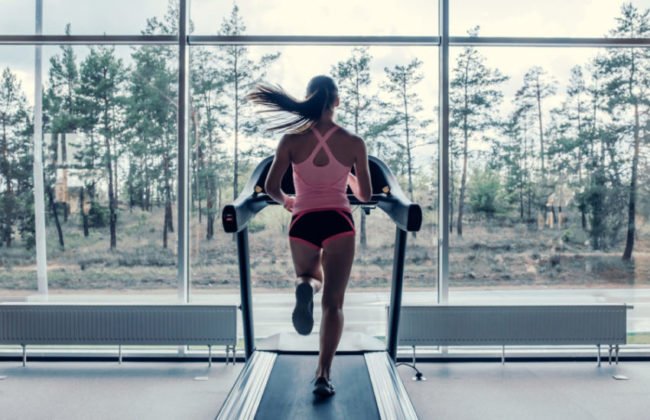
A treadmill is the best machine for burning calories and fat. Interval training on a treadmill combines fast running, slow running, and walking. You can also control the intensity of the training by adjusting the machine’s angle of inclination.
Or you can use built-in programs if available, since they automatically adjust the speed and inclination angle. When it comes to walking, start with a fast walk that is not too demanding.
For example, set the speed to 3mph and the inclination to 0% and walk like that for the entire minute. Then increase the incline to 10% and walk for another minute. Put it back to 0% and walk one more minute. Continue doing so until 10 minutes pass.
As you get in shape, increase either the duration of intervals, the inclination, or the speed. When running on the treadmill, you should apply the same rules as with walking. Run fast for 30-60 seconds, then rest or walk.
For example, set the speed to 7 miles an hour and the inclination angle to 0%, and run for 30 seconds, then rest for 30 seconds. Repeat it 5-7 times. When you’ve adjusted to the workout, increase the speed, or simply decrease the rest period.
Intervals on A Stepper
People love steppers or elliptical trainers because they allow you to burn fat and at the same time, increase muscle strength. However, it is so easy to cheat on a stepper. For example, if you are leaning too much on the hand-holders, you are diminishing the potential of the machine when it comes to calorie burn.
When you are training on a stepper, do not make small steps. Studies show that making larger movements on a stepper leads to bigger calorie burn and activates glutes and quadriceps muscles better.
If you are leaning on the hand bar while you are training not only that you will burn fewer calories, there is also a high risk of a back injury.
Intervals on a stepper are basically in the increase of resistance. For example, set the resistance on a low level and do 50-60 steps in a minute. Then combine a minute of 80-90 steps with a minute of 50-60 steps. Start with five repetitions and increase their number as you get in shape.
Interval Training In other Activities
You can do interval training in almost any sort of sport. If you play tennis, you can bounce the ball of the wall for a couple of minutes and then rest for a minute and so on. If you are playing basketball, you can circle the court four times, having to dunk the ball each time you go past the hoops, then rest and repeat all several times.
All in all, interval training is a perfect way to get rid of unwanted fat and body weight and get in shape!