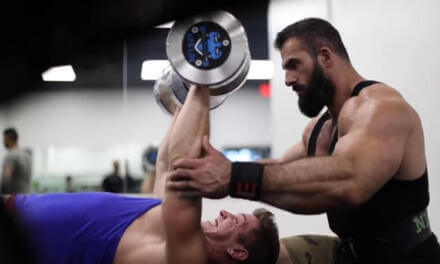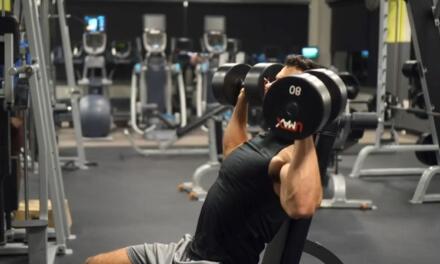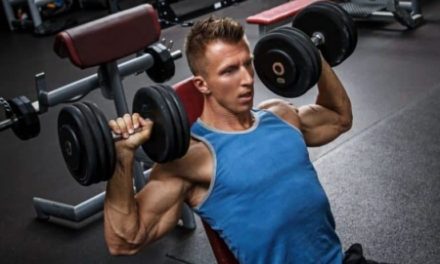

“I can tell you’re working out. How much are you lifting?” That’s the question that almost every person who works out has asked at least once in their life. To most men, the bench press is a measure of strength and power, sometimes even physical abilities.
No one cares that strong legs are more important in most sports than upper-body strength. Everyone considers the bench press as a measure of a man’s strength.
Can you do something to increase your bench press? We will give you a few tips that will help you do it in no time. Next time you go to the gym, pay attention to what everyone is doing when some guy is lifting 150-200kg. (300-400lb)
Usually, all the conversations stop then, and everyone is watching him with envy as he lifts such heavyweights. It seems like other guys are ashamed that they can barely lift 80kg. Funny thing is, they could lift a lot more if they only had a better technique and if they stuck to a scientifically made training program.
If you train regularly and hard, master proper technique, follow a training program that helps you build your muscles and nervous system, and maintain a healthy diet, you will also be able to lift 150kg and more.
The bench press is a full-body workout. The approach most men have to bench press is very wrong.
They pay little to no attention to crucial factors that determine the success in lifting. What those men do is just lie on the bench and raise the bar above their chest, not even thinking of the grip or the correct position of their feet, shoulders, elbows, and hands. Those men usually use the completely wrong bench or bar or are being assisted by incompetent people.
If you figure out the correct technique and the right equipment, you will be able to increase your bench press for 25% up to 50% in a matter of weeks.
Training literature describes the bench press as an upper-body workout that usually helps you build up chest muscles, deltoids, and upper arm muscles.
These muscles are very important for bench press, but if you want to lift heavier weights, you also need to have strong legs, abs, and back muscles, since they are the stabilizers during lifting.
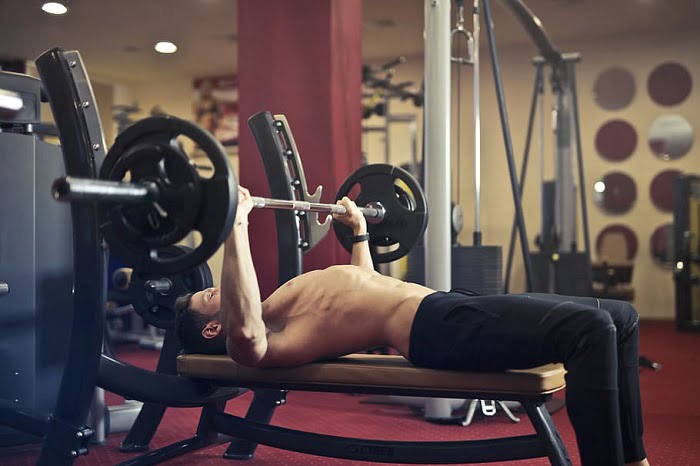
Using the Right Equipment
Olympic Bar
Use the bar specifically designed for weightlifting, and always avoid those that are bent from overuse. Some bars are thicker than others. Choose the one that suits you the best.
Use the bar with the adequate knurled part, so your hands don’t slide all over it, but also make sure it doesn’t hurt your hands while lifting because the knurled part is too rough.
Many lifters use chalk to prevent their hands from sliding. If possible, always use the same bar when lifting, since even the slightest change in the weight of your grip can significantly influence your performance.
Bench
The dimensions of the bench are of utmost importance for optimal performance, as firm leg support plays a critical role in weightlifting. If the bench is too high and your legs are in the air, that is a significant disadvantage from the start.
Most of the benches are 17.5inches tall, so all people of average height can place their feet flat to the floor while having their knees bent in an angle that is a bit smaller than 90 degrees.
Also, the bench should be wide enough to support the shoulders but not too wide to limit your movements. Most of the benches are 12.5inches wide.
Use the bench with bar supports of different heights so you can grasp the bar when your arms are fully extended. If the bar support is too low, you can injure your shoulder joints even when lifting smaller weights.
Finding the right bench can make a massive difference when it comes to the weights you are lifting. Try out benches in different gyms before you decide on the one you will go to regularly.
Basic Bench Press Techniques With 150kg Weights
During a bench press, use all the muscles in your body, not only the chest, arms, and shoulders. Correct posture determines your success. Start by placing your feet firmly on the floor.
Lie on the bench with the bar in line with your eyes. Place your feet on the floor, making sure that the distance between them is the width of your shoulders. Try pulling the feet towards your head, keeping them firmly on the ground.
This position provides stability and simultaneously helps you arch your back and lift your chest. It also allows you to move your legs during the lifting without lifting your behind from the bench. Try keeping your behind on the bench at all times. If you do not do so, you increase the risk of injury.
In the beginning, it will be hard for you to arch your back and lift your chest, but as you get more flexible, this will become easier. This technique allows you to progress quickly, and this position gives you firm support.
Move your shoulder blades towards each other and keep them in this position during every repetition. This will help you to keep the chest out and back arched during the lifting.
Grip the bar firmly with thumbs turned opposite to the other fingers. Do not bend the wrists, and do not do the grip without thumbs.
Initially, the distance between the hands should be slightly wider than the shoulders. The maximum distance between hands shouldn’t be more than 81cm.
The width of the grip is a very individual thing, so you should experiment with a wide and narrow grip. Also, it would be good to change the width of the grip often while training, since different widths activate different muscles while lifting.
Lower the bar, never losing control over it, straight down to your nipples, and then make a short pause, clench the gluteus, and explosively push the bar straight over the chest. Make sure that the shoulders are pulled back and the back arched. Explosive lifting from the bottom of the movement recruits more muscle fibers and motor units.
Most men lift the bar in some curvy trajectory until it is in line with the eyes. Pushing the bar straight decreases the distance it travels, so the lifter uses less energy and can lift heavier weights.
The technique is a crucial element in lifting heavyweights. Always be in good shape, no matter if you are just warming up with lighter 70kg weights or lifting heavier.
Try to lift explosively. Be very focused and train regularly. On high-intensity training, always lift a weight that is half a kilogram heavier than the weight you lifted in the previous training.