

The chief functions of food are to yield energy, build body tissue and regulate body processes. The foods are classified as carbohydrates, proteins, and fats. Carbohydrates are the most abundant food, the least expensive, and the most readily digested.
Understanding Carbohydrates
The term “carbohydrate” indicates that it consists of carbon and water, which coincides with the fact that ordinary cane sugar, on heating, will undergo fragmentation into elementary black carbon and water.
The normal burning of carbon in the air produces gaseous carbon dioxide, water, and heat energy. The digestion of carbohydrates likewise produces the final products, carbon dioxide, and water, with the same heat energy but generated at a much slower rate. We find both of these products in our exhalation and other excretions.
Classification of Carbohydrates
The carbohydrates are classified as to their particle size and degree of aggregation. Starch is termed a polysaccharide because, on digestion, it fragments, it fragments into several thousand units of the important simple sugar; hence, it is called a disaccharide. These fragmentation processes require the utilization of water as a solvent and as a participating reactant.
The types of natural carbohydrates are listed in order from top to bottom as to the increased water solubility and ease of digestion.
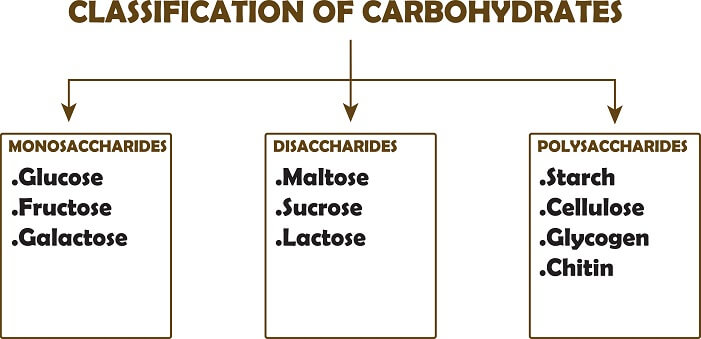
All the polysaccharides are insoluble in water, although they may swell and become granulations. Cooking processes increase this condition because it causes a rupture of the granules.
Starch The Most Abundant Carbohydrate
Starch is the most abundant carbohydrate in the diet, probably since it is so widely distributed in the roots, seeds, and tubers. In the tissue of plants, it is found in the form of granules. These granules are typical of the plants in which they are found and occur in different shapes, sizes, and markings.
Wheat starch granules are oval-shaped, whereas the granules of corn starch are small, rounded, and angular. If you cook food containing starch, it will make them more palatable and more easily digested.
Dextrin, Maltose, and Glucose
Starch is industrially fragmented into dextrins, maltose, and commercial glucose preparations.
Unripe apples and bananas contain much starch, which changes into sugars as these fruits ripen.
Young, tender corn and peas contain sugar which on maturing, changes into starch. This is why such crops are frozen immediately after harvesting.
The starch content of ordinary cereal grains varies from 50% to 75% and constitutes 75%-plus of the solids of mature potatoes. Plant starch represents stored energy that may be used for plant growth and other functions.
Glycogen – Stored Energy
The stored energy in the human body is called glycogen, often called “animal starch.” It is white, amorphous, odorless, and tasteless.
When it contacts water, it swells. There’s around 1lb of glycogen in the human body, mainly in the liver and muscles. This body starch represents stored energy that may be realized when conditions arise that make it undergo fragmentation.

Lactose (best source – milk)
The only natural source of lactose is milk. Lactose, commonly called “milk sugar,” is synthesized in the mammary glands of mammals and women from the carbohydrates in their diet.
Cows milk contains 4% – 5% lactose, human milk, 6%-8%. Lactose has some unique properties that make it superior to other carbohydrates.
Cane Sugar (Sucrose)
Cane Sugar, technically called sucrose, occurs in sugar cane, sugar beet, maple sugar, and certain fruits. Note the ending “-ose” of the names of disaccharides and monosaccharides, indicating that they are sugars.
The word “cellulose” suggests that it will undergo fragmentation to form sugars. Ordinarily, table sugars, also called saccharose, are the most important disaccharide, used in enormous quantities as food.
When cane sugar undergoes digestion, its two fragmentation products are glucose and fructose in a 1:1 ratio.
Fructose is the sweetest sugar known. When maltose is fragmented, it forms only glucose and galactose. In other words, the disaccharides fragment to two similar units of simple sugars, glucose always being one of the products.
Blood Sugar (Glucose)
Our body contains small amounts of glucose, sometimes called “blood sugar.” The three simple sugars, glucose, fructose, and galactose, have identical compositions and more or less have the same amount of energy.
Cellulose is a polysaccharide consisting of thousands of aggregates of glucose. The human body cannot fragment cellulose. Hence, it is not human food but plays an essential role in our diet as an aid to intestinal health. Cellulose is the chief constituent of the walls of plant cells. Wood, paper, cotton, flex, and hemp are mainly cellulose.
The enzymes of our alimentary tract cannot digest cellulose. Still, it is a desirable constituent of our diet since it gives bulk to the feces and therefore tends to prevent constipation. Cattle, sheep, goats and deer, and other species of animals called “herbivores” can derive energy from cellulose because of bacterial fermentation in their digestive system.
Maltose
Maltose, or malt sugar, is formed from starch by the action of certain enzymes and is an important component of germinating cereals, malt, and malt products. It also formed an intermediate product during the digestion of starch in our body.
During digestion of the carbohydrates in our food, the gastric juices and other secretions of our body eventually, fragment into simple sugars. These simple sugars dissolved in water are small enough to pass through the walls of our intestinal tract and enter the bloodstream.
The other more complex carbohydrates are too large in particle size to undergo this diffusion process.
The average composition of the human blood during fasting is:
- Water…………………………..78%
- Proteins………………………..18%
- Carbohydrates………..0.7%-1%
- Fats, Olis……………………….2%
- Minerals………………………..2%
The main carbohydrate in the blood is the simple sugar, glucose. Small amounts of enzymes and hormones in the blood play a vital role in our health.
The liver transforms the simple sugars into glucose, which, in turn, may remain in the blood and undergo aggregation to form body starch (glycogen).
The liver contains 10% maximum glycogen. The muscles have 2% maximum glycogen. And when the body’s activities change, the normal concentration of glucose in the blood, transformations involve the glycogen to bring the glucose content of the blood back to normal.
15% Raise In Glucose After Meals
Right after a meal, the glucose content rises to 12%-15%. The high blood sugar content is reduced over several hours to the normal concentration through a hormone known as insulin. Insulin has the unique property of causing glucose particles to unite or aggregate to form body starch.
Some unhealthy people have excessive amounts of insulin, which leads to lower than usual glucose content in the blood. This condition, known as hypoglycemia, produces such symptoms as excessive sweating, nervousness: tremors of the lips and hands, blurring of vision, and dizziness. Continuous hypoglycemia may lead to coma and death.
Hypoglycemia is usually treated with the administration of sugar by mouth or intravenous injection of glucose solution. The latter gives a much more rapid response.
Diabetes Mellitus
Some people who lack the proper amounts of insulin have a sickness known as diabetes mellitus. Another type not dependent on insulin is “diabetes insidious.” This condition leads to marked thirst and excessive urination. (polyuria)
Since insulin transforms blood sugar into stored glycogen, low insulin naturally leads to higher than normal blood sugar. One factor that sets an upper limit to blood sugar is its excretion in the urine. Whenever the blood sugar level rises to a certain point, such as 15%-18%, called the renal threshold, urinary excretion occurs. The diabetic individual may have 3%-5% glucose in their urine.
Periodic laboratory tests for the detection and estimation of glucose in the urine should be made for a person that shows symptoms of diabetes.
One signal a person may have diabetes is excessive urination and a marked thirst. The appetite and thirst of someone hyperglycemic is enormous, yet the body weight becomes progressively less. Continuous high blood sugar can cause the carbohydrates in the diet to transform into acidic substances, leading to acidosis.
Uncontrolled diabetes can lead to coma or death. The injection of insulin subcutaneously will reduce the blood sugar down to normal content. However, excess insulin can lead to glycemia. Insulin cannot be successfully delivered by mouth because enzymes destroy it in the alimentary canal.
Insulin levels Affected By Infection.
The effectiveness of insulin in the body is reduced by infection. This is why doctors stress the importance of cleanliness. People who have diabetes should carefully wash daily, especially their feet, and change their socks daily. A diabetic person with an infection can be in real trouble.
Glucose and Exercise
During mild physical activities, the blood glucose content tends to decrease. The glucose is constantly being replaced by the action of the hormone epinephrine on glycogen.
The fragmentation of the body’s starch in the liver forms glucose. During vigorous exercise, the body starch in the muscle is changed by the adrenalin into lactic acid.
The muscle eventually becomes loaded with lactic acid and exhaustion results. During rest, the lactic acid is carried by the blood to the liver, wherein most of this substance is changed back into glycogen.
During mild activity, the glycogen in the muscles is converted by a series of changes to form carbon dioxide and water.
Lactose
Lactose is less sweet and much less soluble than cane sugar.
The solubility of lactose is about 1 part in 6 parts of water. Lactose in the stomach is much less susceptible to fermentation than cane sugar. Due to its lower solubility, there is much less danger of direct irritation in stomach membranes.
The chance of building up an acidic condition (acidosis) is much less for lactose and its fragmentation product galactose than for other sugars.
Lactose and galactose are superior to the other sugars in that they favor the development and maintenance of the desirable types of intestinal bacteria, ensuring excellent intestinal health.
Some nutritional experts believe that lactose galactose is closely involved in the growth of the galactosides of the brain and the nerve tissue, especially important for the rapidly growing infant. Many experts recommend large amounts of milk and milk products in the diet.
Carbohydrate Food List
Carbohydrates are present in most food. Cane sugar represents 100% carbohydrate content. The important foods containing 50% or higher are listed below.
- Barley, pearled beans – dried
- Crackers
- Corn meal
- Currents
- Dates
- Doughnuts
- Farina
- Figs
- Flour
- Hominy
- Honey
- Macaroni
- Macaroon
- Marmalade
- Mincemeat
- Molasses
- Oatmeal
- Peas, dried
- Potatoe chips
- Prunes
- Raisins
- Rice
- Zweiback
If people subsisted solely on carbohydrates, they would become unhealthy and eventually perish because the enzymes, hormones, and some vitamins are absent from such foods or do not contain the proper ingredients to make those substances in the body.
It must be stressed that a healthy person must eat carbohydrates, proteins, and fats because they are all needed by the body, and the proper results necessitate all three together because their regular digestion and assimilation are interdependent. Another important fact is that their ratio is extremely important. The digestion results of each alone is quite different than when adequately mixed. Each one has a beneficial effect on the other.
Each one has certain specific functions in the body. In the body, if conditions necessitate, proteins may be changed to carbohydrates or fats. Carbohydrates and fats may be converted into the other, but they cannot be transformed into proteins. This difference is because carbohydrates and fats contain carbon, hydrogen, and oxygen, whereas protein has a fourth element, namely nitrogen.