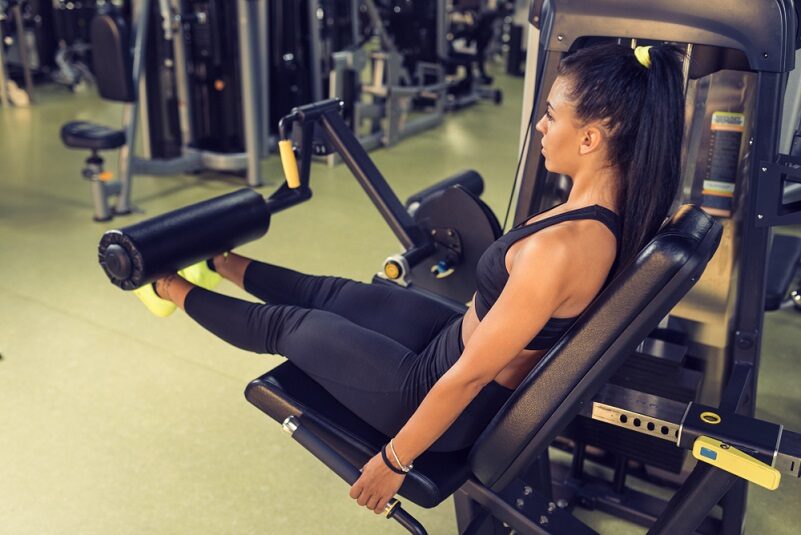
The leg extension is considered an isolation exercise since it targets the quads with minimal participation of the other leg muscles.
This exercise is also very often done in the phase of warming up as a preparation for other, much more complex and harder exercises, such as squats or leg press.
The advantage is that not only does leg extension warm up the thighs, but it also prepares the knees for all the difficult exercises that follow.
But even with a simple exercise as the leg extension, you need to be careful. If you do it incorrectly, it can cause serious damage to your knees.
Those injuries are nasty since you basically can’t see them coming, since they occur over time, not at once. How can you damage your knees by doing leg extensions?
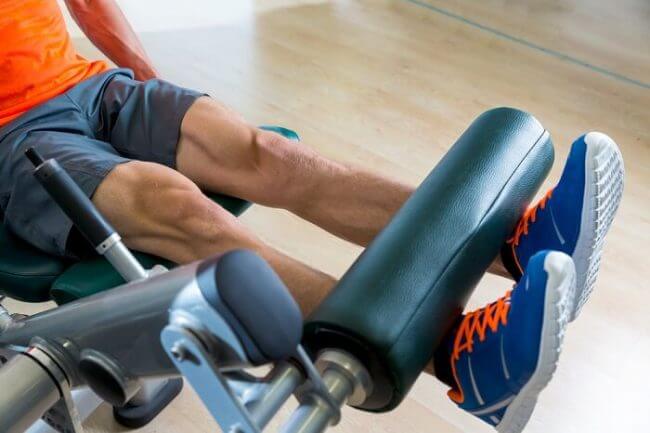
Disadvantages of Leg Extension – Knee Injury
The angle between the upper and lower parts of your legs shouldn’t be smaller than 90 degrees in the starting positions. If this angle is smaller, then it causes hyperextension of the kneecap and that gradually leads to the damage of cartilage and connective tissue.
Cartilage can be severely damaged, and you can get a serious form of arthritis. People often think that lifting heavy weights causes arthritis, and that is not true.
Truth is that lifting heavy weights can cause damage to the joints and arthritis only if the joints are at an unnatural angle while you are lifting.
Second, a very common mistake is the use of very heavy weights. In complex exercises like squats and leg press, the weight is distributed evenly throughout the body, thereby putting less pressure on the knees.
The correct way to do leg extensions is to use smaller weights, or those weights with which you can do at least twelve reps in a set. Leave heavier weights for more complex exercises. Do not extend the knees fully while you are lifting your lower legs.
Leg extension is often used as a rehabilitation exercise to treat various injuries, but it is always performed with lighter weights.
The knees are not the only body part that we can injure while doing leg extensions. Most of the machines for leg extension have adjustable backrests so that people of different heights can use them properly.
Analysis was done on the effect of the angle between the seat and the backrest, and it has shown that an inadequate angle exposes the back to high pressure, which can lead to injuries to this part of your body. People very often sit on the machine and start doing the reps without adjusting the backrest, which is a big mistake.
In the analysis we mentioned earlier, they studied the effect of three different backrest angles on activity in the lower back and the frontal quads.
The goal of the analysis was to determine the angle that places the lower back under the lowest possible pressure while maximally activating the quads.
They came to the conclusion that the best angle is ninety degrees, meaning that the backrest is at the right angle compared to the seat.
When the backrest is at a sharper angle, the pressure on the lower back increases and the activation of the quads decreases, you should also know that muscle activation is much better if you do the leg extension with both legs at the same time, than if you do it one leg at the time.
This makes leg extension different from other leg exercises, where training one leg leads to much better muscle activation.
Feet Position
What can affect the activation of different areas quads while you are doing leg extension is also the position of the feet while you are exercising.
If your feet are stretched downwards, then the most affected area is the vastus lateralis, the outer part of the quads. When you point the feet upwards, then the most affected muscles are the rectus femoris, vastus medialis, and vastus intermedius.
Reason for this is that it comes to changes in muscle activation due to different positions of the feet because those positions trigger the inner rotation of the thighs and muscle extension that transfers the accent of the exercise from one to the other part of the thighs.
It is probably best to use both positions of the feet while you are exercising, but also the neutral position, in order to activate all the muscles in the frontal area of the thighs.
Neutral position of the feet in leg extension activates all four of the earlier-mentioned muscles equally. If time is the issue, you should do leg extension always in a neutral position unless, of course, some parts of the thighs are your weak points, and you need to work on them more.
Conclusion
As we already said, there are numerous advantages to leg extensions, and it is a very good exercise for warm-ups. As long as you make sure that the angles of the knees and the backrest are adequate, there is nothing to worry about.
We really hope our tips will help you enjoy this great quad exercise and that you will include it in your workout program if you haven’t done so already.